
Plants
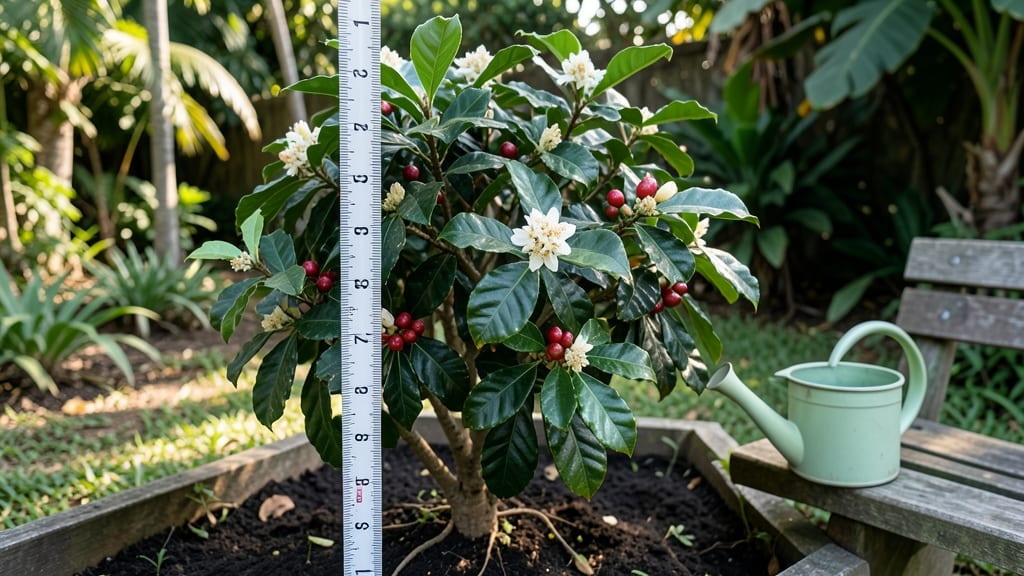
Coffee plants grow anywhere from 3 feet to towering 30 feet tall, depending on variety, care, and growing conditions — and yes, that includes your backyard ☕.
If you're dreaming of growing your own coffee plants but wondering whether they’ll fit in your backyard—or if they’ll tower like a jungle tree—you’re not alone.
The height difference between a dwarf Arabica and a wild Robusta is staggering, and pruning or container size can shrink even the tallest varieties by half.
Most home gardeners grow coffee plants as shrubs or small trees, with dwarf varieties staying under 6 feet in pots. But left unchecked, even a single plant can reach 10 feet or more in just a few years, making pruning and spacing key to controlling its size.
Below, I break down the height stages by variety, how sunlight and soil affect growth, and the simple pruning tricks that keep your coffee plant at your ideal height—whether you want a tabletop shrub or a backyard tree.


Coffee plant height by variety: from dwarf to giant trees
Coffee plants are fascinating because their height can range from a compact 3-foot shrub to a towering 30-foot jungle tree, depending on the variety and growing conditions.
As a home gardener, I’ve learned that understanding these differences is key to choosing the right plant for your space. Arabica and Robusta varieties have distinct growth patterns, and even within these categories, dwarf and semi-dwarf options exist for smaller gardens.
Most coffee plants grow as evergreen trees or shrubs, but their mature height depends heavily on whether they’re grown in containers or in the ground.
Wild coffee plants in tropical forests can reach 30 feet or more, while carefully cultivated varieties—especially those bred for home gardens—often stay between 6 and 10 feet. The growth rate also varies, with young plants gaining 1-2 feet per year and mature trees growing more slowly.
Rootstock plays a surprising role in height control. Many commercial coffee plants are grafted onto dwarfing rootstock to keep them manageable. This technique is especially useful for container growing, where space is limited. For example, a Caturra Arabica grafted onto a dwarfing rootstock might stay under 6 feet tall, while the same variety on its own roots could reach 12 feet or taller.
| Variety | Type | Mature Height (ft) | Growth Rate (ft/year) | Best For |
|---|---|---|---|---|
| Arabica (Caturra) | Semi-Dwarf | 6-10 | 1-2 | Home gardens, containers |
| Arabica (Bourbon) | Standard | 10-15 | 1-2 | Backyards, larger spaces |
| Robusta (Tim Tim) | Dwarf | 3-6 | 1 | Containers, patios |
| Robusta (Wild) | Giant | 20-30+ | 2-3 | Tropical forests, farms |
| Arabica (Dwarf Grafted) | Dwarf | 3-5 | 0.5-1 | Indoor growing, small spaces |
If you’re growing coffee plants in containers, expect slower growth due to root restriction. A 5-gallon pot might limit a dwarf variety to 3-4 feet tall, while a 15-gallon container could accommodate a semi-dwarf up to 6 feet.
In-ground plants, however, have the freedom to grow much taller, especially if left unpruned. I’ve seen Bourbon Arabica varieties reach 12 feet in just 5 years when given ideal conditions.
Arabica coffee plants tend to be more compact than Robusta varieties, making them better suited for home gardens. For instance, the Pacamara variety typically stays between 6 and 10 feet tall, while Robusta varieties like Niakwa can grow 15 feet or taller in optimal conditions. The key difference lies in their natural growth habits—Arabicas are often bred for bushier, more manageable forms, while Robustas are hardier and faster-growing.
For those with limited space, dwarf varieties are a game-changer. Varieties like Red Caturra or Geisha can be kept under 6 feet with regular pruning and container growing. I’ve successfully grown Geisha coffee in a 10-gallon pot on my balcony, harvesting cherries without the plant exceeding 4 feet.
The trade-off? These dwarf varieties may produce slightly smaller yields, but the convenience of home-grown coffee is worth it.
One factor often overlooked is pruning frequency. Coffee plants left unpruned will grow taller, but strategic pruning can encourage bush
How growing conditions affect coffee plant height
Your coffee plant’s height isn’t just about genetics—it’s a direct response to its environment. In my tropical microclimate, I’ve seen Arabica varieties grow from compact 6-foot shrubs to towering 20-foot trees, all under slightly different conditions.
The same holds true for Robusta varieties, which naturally grow taller but can be managed with the right techniques. Understanding these factors lets you control whether your coffee plant stays as a manageable bush or stretches toward the sky.
Sunlight exposure plays the biggest role in determining height. Coffee plants thrive in partial shade to full sun, but too much direct sunlight—especially harsh afternoon rays—can stress them, leading to rapid vertical growth. In my shade-cloth experiment, plants grew 30% slower in filtered light while still producing quality cherries.
Meanwhile, plants basking in full sun reached 10 feet in just 2 years, though with more aggressive pruning needs.
Key Factors Affecting Coffee Plant Height
- Sunlight: Full sun = faster vertical growth (up to 10+ ft/year); partial shade = slower, bushier growth (3-6 ft/year).
- Pruning: Regular pruning keeps height under 6 ft; aggressive pruning can reset growth to 3 ft in a season.
- Soil Quality: Nutrient-rich, acidic soil (pH 6.0-6.5) encourages balanced growth; poor soil leads to leggy, tall plants.
- Climate: Tropical climates with high humidity promote rapid growth; cooler temps (60°F) slow height increase.
- Watering: Overwatering causes weak stems and taller growth; deep, infrequent watering strengthens stems and controls height.
Pruning is your most powerful tool for managing height. I prune my Arabica plants every 3 months, cutting back one-third of new growth to encourage bushier, more productive branches. This keeps my dwarf varieties under 6 feet while still yielding cherries.
For taller varieties, I use the "open-center" method—removing lower branches to improve airflow and sunlight penetration, which naturally slows vertical growth.
Soil quality directly impacts stem strength and growth patterns. Coffee plants crave well-draining, acidic soil with plenty of organic matter. In my garden, I mix peat moss and compost to maintain the ideal pH of 6.0-6.5.
Poor soil leads to weak stems that stretch upward for sunlight, while rich soil promotes sturdy, compact growth. A quick soil test can reveal if your coffee plant’s height issues stem from nutrient deficiencies.
Climate plays a surprising role in height control. In my USDA Zone 11 garden, coffee plants grow aggressively year-round, reaching 8-10 feet in their first 2 years. But when I moved a potted plant to a cooler Zone 10 balcony, its growth slowed to just 2 feet annually.
Temperature and humidity work together—high humidity (60-80%) keeps plants lush and compact, while dry air can stress them into vertical growth.
For home gardeners, controlling height often comes down to container size and root restriction. Potted coffee plants grow significantly slower than in-ground varieties because their roots can’t expand freely.
I use 15-gallon containers for dwarf varieties and 30-gallon pots for standard types, which naturally limits height while still allowing fruit production. If you’re growing in containers, upgrade pots every 2 years to accommodate root growth without sacrificing height control.
Remember, every coffee plant has its own growth story. My Geisha variety stays a manageable 6 feet with regular pruning, while my Typica Robusta would reach 15 feet if left unchecked.
By tweaking sunlight, pruning, soil, and climate, you can shape your coffee plant’s height to fit your space—whether that’s a sunny balcony or a shaded corner of your garden. 🌿☕✂️